Choosing a hive
The main hive types used in Australia (Langstroth, Flow Hive, top bar and Warré), the rule that every hive must allow inspection, and how they compare.
Several hive designs are in use. Every design has to meet one requirement first: the combs must be able to be taken out and inspected. This page sets out that rule, compares the four common types, and gives steps for choosing.
Step 1: Check the rule every hive must meet
The national Australian Honey Bee Industry Biosecurity Code of Practice requires hives that allow “combs to be individually and separately removed from the hive for easy inspection”. BeeAware advises checking the brood and colony at least several times a year in spring, summer and autumn, and removing and checking each brood frame in turn. A hive that does not let you do this cannot be checked for disease.
State and territory rules are set separately:
| State | Rule |
|---|---|
| NSW | The department’s registration page says your bees must be kept in a frame hive. |
| Tasmania | Bees must be kept in a “standard hive” (a box with vertical frames that can be readily removed so the honeycomb can be examined) or in a hive type approved by the Chief Plant Protection Officer. |
Before buying or building any hive other than a standard box-and-frame hive, check your state or territory department’s current apiary rules. Registration is also required: see Registering your hives.
Step 2: Understand why frames lift out
Honey bees leave a small gap, about 6 to 9 mm (roughly a quarter to three-eighths of an inch), between their combs. This is called bee space. Bees seal any gap smaller than this with propolis, a sticky resin, and fill any larger gap with extra comb.
Hives built around bee space keep a gap of this size between frames, between frames and the walls, and between boxes. The bees then leave the frames unglued, so each frame can be lifted out without destroying the comb. The American beekeeper Lorenzo Langstroth built his hive around this gap, and the Langstroth hive is named after him.

Step 3: Compare the four types
| Langstroth | Flow Hive | Top bar | Warré | |
|---|---|---|---|---|
| Layout | Stacked boxes of frames | Langstroth-style boxes with Flow frames in the honey super | One long horizontal box with bars | Stacked boxes of top bars, new boxes added underneath |
| Taking honey | Frames spun in an extractor, comb reused | Honey drains through a tap | Comb cut from the bars, comb not reused | - |
| Inspection | Lift out each frame | Brood box inspected like any other hive | Lift out one bar at a time | Limited, by design |
| Standardised, interchangeable parts | Yes | - | - | - |
A dash means no reliable source was found.
The Langstroth hive
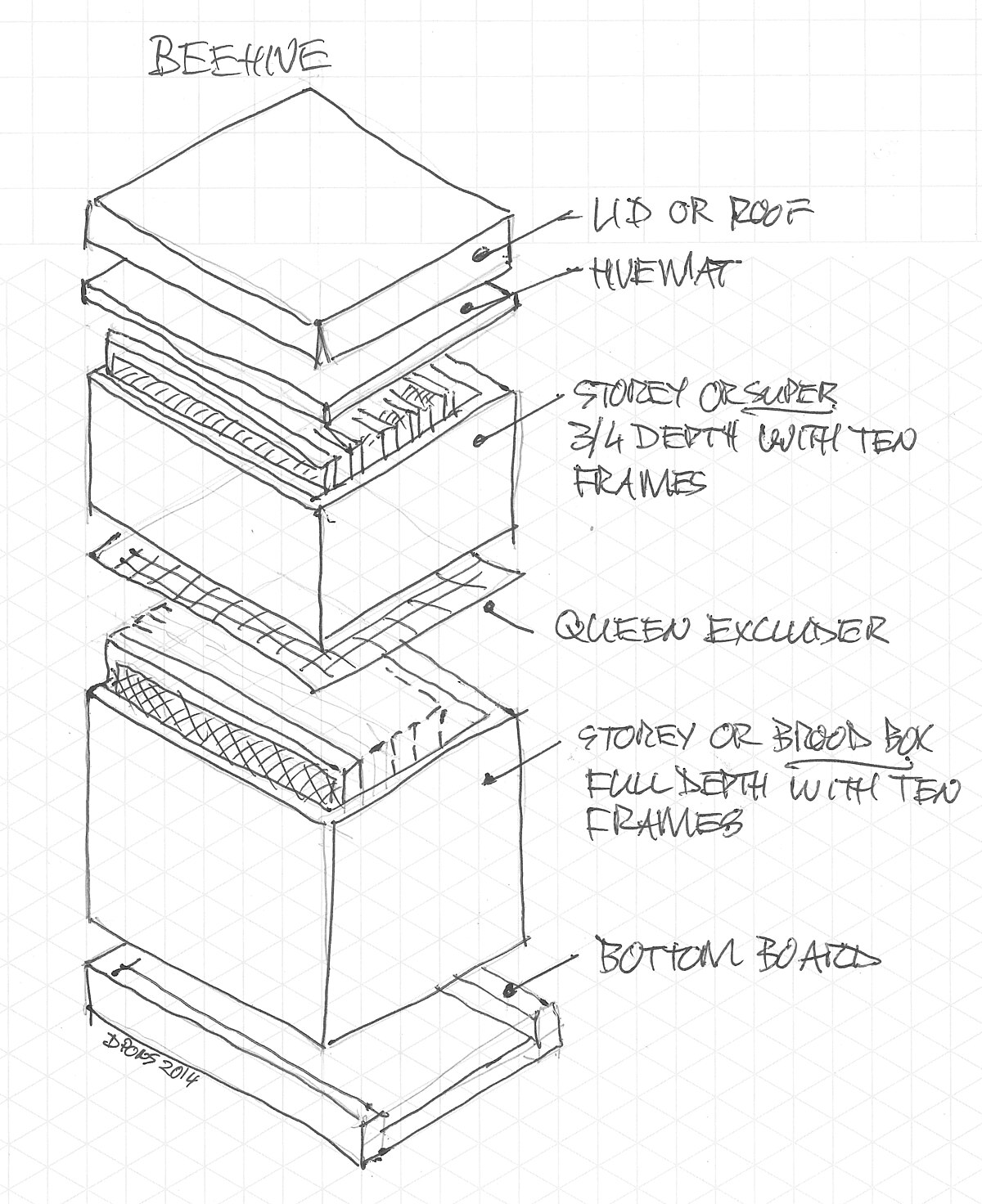
A stack of boxes holding removable frames. From the bottom it has a bottom board, a brood box where the queen lays and young bees are raised, an optional queen excluder, honey supers above for surplus honey, and an inner cover under a weatherproof outer cover.
The parts are standardised, so equipment from different makers generally fits together, although slight differences between makers do occur. Extractors spin the honey out of the frames and the empty comb goes back into the hive for reuse.
Widths and depths. Boxes come in two widths: 10-frame and 8-frame. The 8-frame boxes come in the same depths but are narrower and slightly lighter. Frames must match the box, so choose one width and keep to it. Deeper boxes are generally used for the brood, and shallower ones for honey. A full box of honey is heavy, and the deepest boxes are the heaviest, so think about whether you can lift the size you choose, repeatedly, when it is full. Depth names and exact sizes vary, so ask your supplier or local club what they stock and use one size consistently.
The Flow Hive
Invented in Australia by Stuart and Cedar Anderson and launched through a crowdfunding campaign in 2015. It is used like a Langstroth hive: a brood box below and a honey super above, which holds special Flow frames in place of ordinary ones. Flow frames are split vertically, and the bees finish and fill the cells as they would on any frame. To harvest, you turn a handle or crank. This opens channels through the comb and the honey drains out through a tap, without disturbing the bees.
The brood box still needs regular inspection. The manufacturer’s own support page says all Flow Hives must be opened for inspection like regular hives, to check for pests and disease. This matches BeeAware’s advice to inspect the brood several times a year.
The top bar hive
A long, horizontal box with bars resting along the top edge. The bees hang their comb from each bar, usually without foundation or frames. Honey is harvested by cutting the comb from the bars, so the comb cannot be reused as it can with Langstroth frames. It cannot be spun in a centrifuge, and the bees have to rebuild comb after each harvest, so top bar hives are described as giving less honey. Inspection means lifting out one bar at a time.
The Warré hive
Stacked vertically like a Langstroth, but its boxes hold top bars rather than full frames. When the colony needs more room, new boxes are added underneath rather than on top. The design aims for minimal disturbance, so inspections are limited. That makes it important to check your state’s rules before choosing one, because the hive still has to let you examine the comb for disease.

Step 4: Choose
- Confirm your state’s rule on hive types (Step 1).
- Ask your local beekeeping club what they use. See Clubs and associations.
- Decide what you can lift. Full boxes are heavy, so pick a box depth and width you can handle repeatedly.
- Choose one design and one box size, and keep to it so parts stay interchangeable.
- Read What you need to start before you buy.
No design is best for everyone. Whichever you choose, it must let you remove and inspect each comb.
Photo credits
- Langstroth hive parts (drawing): Dirk Pons, Wikimedia Commons, CC BY-SA 3.0.
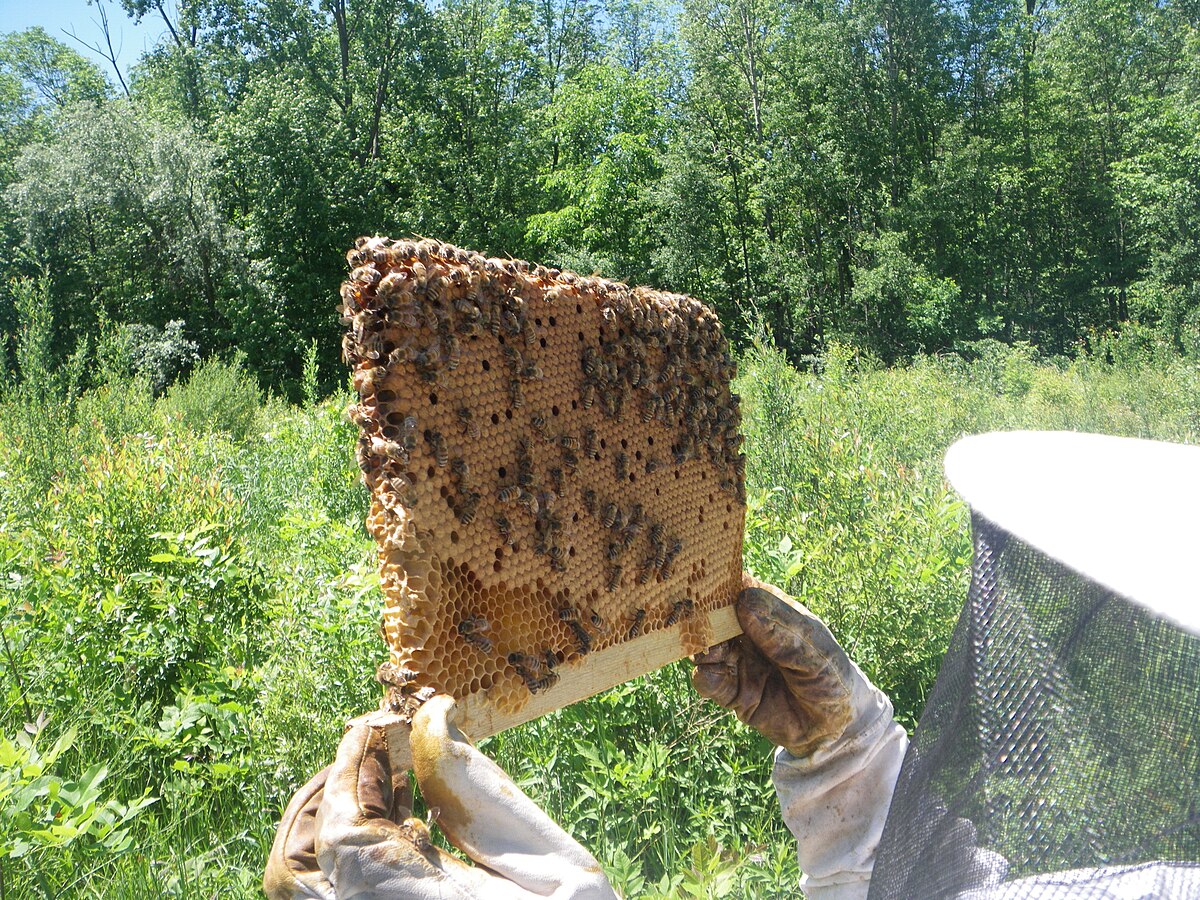
- Warré top-bar comb: shawn caza @ beekeeping.isgood.ca, Wikimedia Commons, CC BY-SA 3.0.
Sources
Every fact on this page was checked against at least two independent sources.
- Hive construction and labelling (Code of Practice, section 6)BeeAware / Plant Health AustraliaOfficial
- Inspecting hivesBeeAware / Plant Health AustraliaOfficial
- General Biosecurity Direction (Apiaries), 15 December 2022Biosecurity Tasmania (Department of Natural Resources and Environment Tasmania)Official
- General Biosecurity Direction - ApiariesBiosecurity Tasmania (Department of Natural Resources and Environment Tasmania)Official
- Flow Hive (STEM video resource catalogue)NSW Department of EducationResearch and industry
- Beekeeping Basics, Part 2: Introduction to the Bee HiveUniversity of Arkansas System Division of Agriculture, Cooperative Extension ServiceResearch and industry
- Beekeeping Equipment - Hive Boxes (ENTO-100)Texas A&M AgriLife ExtensionResearch and industry
- Housing honey beesMontana State University ExtensionResearch and industry
- Thriving Hives: The Apiary - Beekeeping EssentialsUtah State University ExtensionResearch and industry
- Beekeeping equipmentUniversity of Delaware Cooperative Extension (MAAREC)Research and industry
- Hive information: basic types of modern or movable hives in common useManchester & District Beekeepers' Association (UK)Research and industry
- Flow Hive creates a buzz among beekeepersFarm and DairySupporting
- Like investors to honey: Aussie beekeeping startup smashes Indiegogo crowdfunding campaignSmartCompanySupporting
- Pests, disease, varroa and AFB (Flow Hive support)Flow Hive (manufacturer)Supporting
- The difference between top bar, Warré and Langstroth hivesMother Earth NewsSupporting
- Beekeeper registrationNSW Department of Primary Industries and Regional DevelopmentOfficial