Feeding, water and forage
When bees need feeding, what to feed and what never to feed, how to avoid robbing, and how to give bees water and good forage.
Bees normally feed themselves. Feeding is a fix for a shortage of nectar or pollen, not a routine. This page covers how to tell when a colony needs help, what is safe to give, and how to do it without starting robbing or spreading disease.
Check stores first
Stores are checked at every inspection (see inspections and records). Each time:
- Look at the frames around the brood for capped and uncapped honey.
- Look for pollen packed in cells near the brood.
- Note whether the weather and forage are likely to improve soon.
Feed to prevent starvation, or as part of managed stimulation before a flow. Extension Australia advises feeding responsibly, and following the Biosecurity Code of Practice.
What to feed
| Feed | Notes |
|---|---|
| Sugar syrup | The standard feed. AgriFutures describes feeding syrup at 1:1 to keep colonies breeding while nectar is scarce. |
| Dry sugar | Some beekeepers give it in a frame feeder. Check your state department’s advice on when it suits. |
| Pollen or pollen substitute | Used when natural pollen is scarce. Trials have given mixed results (Extension Australia), so it is not always worth the cost. |
For stronger syrup for winter stores, check your state agriculture department’s feeding guide (for example NSW DPI’s Primefact 1343, Feeding sugar to honey bees) rather than relying on a general rule.
Never feed honey or pollen from another hive
American foulbrood spores can be present in honey and pollen. Business Queensland says not to feed bees honey or pollen unless it has been sterilised by gamma irradiation, and BeeAware says never to feed hives honey or pollen from other colonies unless it has been irradiated. The simple rule is to feed sugar syrup. See foulbrood.
Sugar and your honey crop
Honey made from sugar feed may not meet the legal honey standard. Check your state department’s advice before feeding colonies that you expect to produce honey for sale.
How to feed
- Feed inside the hive where possible. Robbing is one way American foulbrood spreads between colonies (BeeAware).
- Use a frame feeder inside the box.
- If you use an open feeder, put something in it, such as hay or straw, so bees do not drown (Extension Australia).
- Keep livestock away from external syrup, which can be fatal to them (AgriFutures).
Preventing robbing
Robbing is when bees from other hives raid a weaker one. BeeAware notes that a weakened colony becomes a target, and robbing bees can carry disease spores back to their own colony.
- Do not spill syrup in the apiary.
- Feed inside the hive.
- Keep entrances reduced on weak colonies.
- Never leave wax, honey-covered frames or extraction gear where bees can reach them.
Water
Water is essential to colony survival, and use rises in hot weather (AgriFutures).
- Provide a clean, fresh water source near the hives.
- Set it up so bees cannot drown (AgriFutures). Floating sticks or corks are a common method.
- Keep it topped up through hot spells.
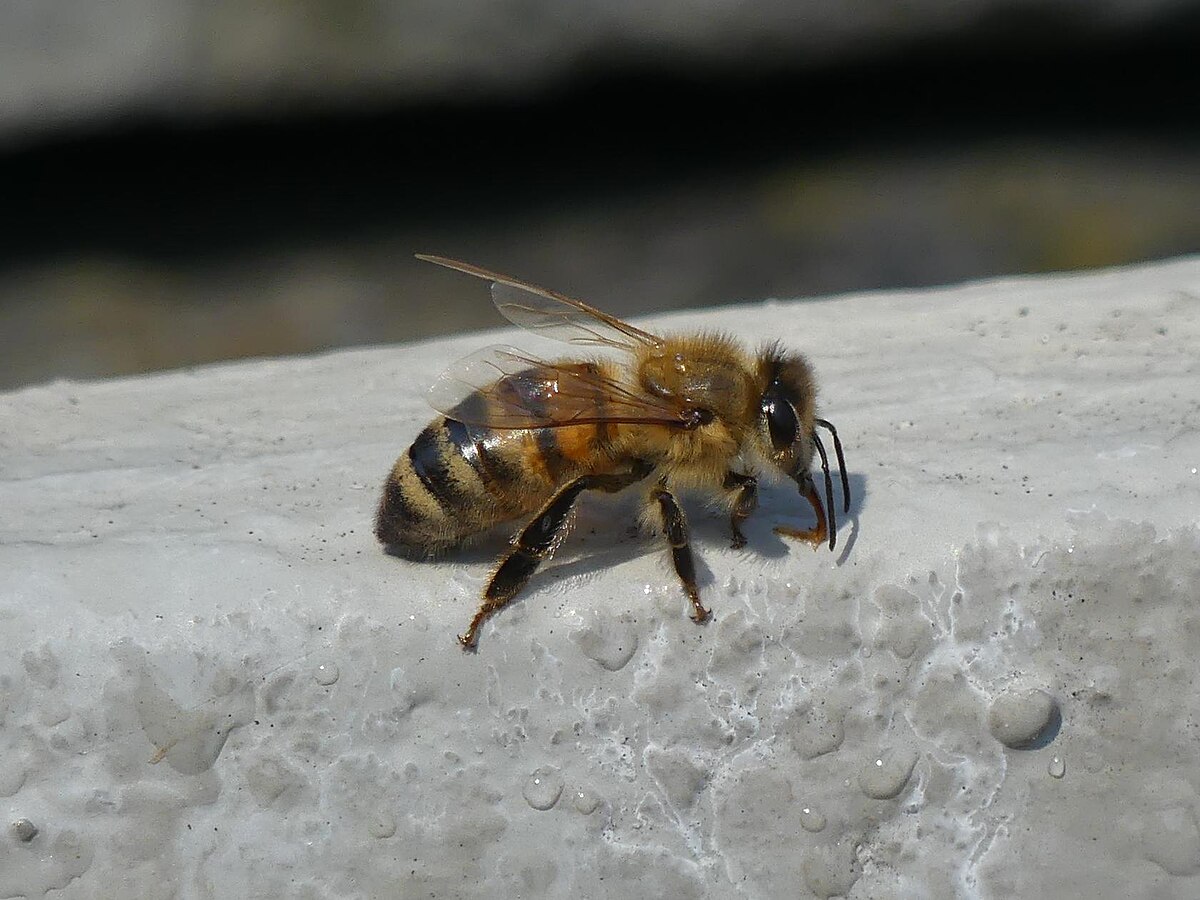

The sources used here did not confirm any local council rules on water for bees, so check your council’s rules on keeping bees.
Forage
Forage means the flowers bees collect nectar and pollen from. Colonies do best where flowers are available across the year. In drought, flowering herbs, pasture and weeds disappear, fresh pollen becomes scarce, and colonies first use stored pollen and then decline once it runs out (AgriFutures). That is when supplementary feeding is most likely to be needed.
To help forage, you can:
- note what flowers near your hives through each season and where gaps occur
- plant a range of flowering plants suited to your local climate
- ask your local club and department about local forage
Checklist
- Check stores at every inspection.
- Feed sugar syrup only. Never feed honey from another hive.
- Feed inside the hive.
- Clean up spills, and keep wax and honey gear away from bees.
- Provide water that bees cannot drown in.
- Record what you fed and when.
Photo credits
- Bee drinking water: Reinhard Müller, Wikimedia Commons, CC BY-SA 4.0.
Sources
Every fact on this page was checked against at least two independent sources.
- American foulbroodBusiness QueenslandOfficial
- American foulbroodBeeAware (Plant Health Australia)Official
- To feed or not to feedExtension Australia (Professional Beekeepers)Research and industry
- Bee management information for drought and fire affected areasAgriFutures AustraliaResearch and industry